2013-05-21

Cry me a river...of krugerrands

I think our vessel would qualify as the bum boat to this.
Privilege is relative. I am well aware, coming from a familial background of distinct financial humility, that to own a boat in which one may swan about locally, never mind one in which the crew proposes to bugger off around the planet for a few years, is a relative privilege, when compared to the lot of the "what garbage shall we scavenge for unrotted protein" lot of untold millions of humans.

The author's ancestors prior to the decision to emigrate.

Nonetheless, over this past weekend, I installed a wine fridge in the kitchen (a gift from my appliance-potty sister) and disposed of a (broken) elderly dishwasher (also a gift, but alas, an unneeded and now long-deceased one used basically as a countertop). The wine fridge looks nice: it eats a mere 1.5 amps, and yes, we drink two or three bottles of reasonably priced red per week. It's part of the more-or-less Mediterranean diet I wish to cultivate on land and sea, after all. And Neptune knows I've been cultivating a diet of late...I may need to downsize the foulies.

Very nice in the kitchen, but not wanted on the voyage.


But the undeniably bourgeois activity of not only unpacking a wine cooler cabinet, but selecting which wines shall be cooled from the wine cellar (an elderly IKEA rack in the laundry room I've had since I started collecting cheap wine in my 20s) made me consider how the relative privileges of drinking nice wines and sailing nice if non-mega sailboats are relative indeed to the problems of, say, mega-yacht owners who have run out of 100 metre docks to which they can tie their floating heli-pads/fun sub ejectors.
Mega-yacht Octopus: I'm surprised it's not called "The Blue Screen of Death", really. Nice waterline, however.

We don't own a car and so, unlike mega-yacht owners, our "parking problems" usually start and finish with finding a post to which to lock our bicycles. The problem of parking is apparent even to us, however: should I wish to take advantage of it, we could earn $100-$200/month by renting out half our garage, but I prefer to keep it as my bike barn, sail loft and man cave, thanks. Clearly, however, owning stuff comes with it the need to put it somewhere, no less for a Russian plutocrat as for the owner of a J/24. One of the keys to "privilege", therefore, is to simply refuse to purchase classes of items that require knock-on expenses: no car, cable TV, use libraries, don't carry a credit card balance, barter goods and services, walk/bike a lot, etc. It is not hard to do these things, but it does require a sort of determination to avoid falling into the "trap of stuff" and to try to maximize value in most of life's little transactions. Because the whole basis of our economic system is that others are trying to maximize value from you:  to buy access to channels you don't watch because you have memberships to gyms you don't attend because you are working harder and longer than ever because you have a mortgage (French for "death contract or gamble") and car payments and grass treatments and bikini waxing and...well, I found it all too much personally even before I had the money to spend on it. Note: I have never spent money on bikini waxing.

We don't take vacations, or at least haven't in the last dozen years, except for camping weekends on a friend's land, yacht deliveries (not really super-relaxing...), and, of course, selected weekends on the (smaller) boat a couple of times a summer in a 100-NM radius. It's a modest outlay, our leisure, geared not only to saving money, but in the rather Protestant anticipation that the "reward" of the actual pushing-off from the dock will constitute the start of a lifetime's worth of vacations, only run continuously.

Realistically, we do not have the income to pull this off. That's what the "cruiser budget" information says. We do, however, have the habit of modest living, and the anticipation that rental income (from the house we are not required to sell up in order to sail) and our own rather portable skills will create enough cash flow to pay for food, sundries, boat consumables and repairs.

That's the hope, anyway. Ours is not a retirement dream so much as a working sabbatical, if that makes sense. I fully anticipate that both myself and Mrs. Alchemy will have to work until the Topsiders are skyward...after we do our trip.

But we will have done the trip...that I can live with. And a privilege I hope to earn, Krugerrands optional.

2013-05-14

Boogie on the water?

Sealant trimmer and auxiliary caulking iron...oh, and pizza slicer.

It's not unusual when one is in "boat mode" to look at lubberly or commonplace objects with a squinty, sailorly gaze. A serrated breadknife could be handy to cut a line on deck, a pizza slicing wheel could make a nice clean-up tool for overflowing bedding sealant. It's very common to see the sort of "picker-uppers" found beside the recliners of the elderly, for instance, aboard boats with deep bilges.

Used several times a day during the engine installation.
Slocum had a crippled alarm clock to aid his navigation, after all. It doesn't all have to be "marine gear", although if it isn't, you'd better have anti-rust treatments handy.

A man who knew how to tack.
Cheap LED headlamps...seriously cheap, not the nice xenon ones cave explorers and rock climbers have, are great "hands-free" illumination for the sailor. I haven't done a delivery without one. They usually last that long without corroding.

Add a red scrim for nighttime chart work...why not?

Also, I have never bought sailing gloves. Gardening gloves of the "rubber dot" type or a variety of half-fingered cycling gloves (which I almost always wear to bike to the boats) are a reasonable substitute at a fraction of the price.
Endorsed by "Wheelie" Harken himself.


It was in that spirit that I looked recently at a sort of toy my son, who needs penmanship practice fairly badly, received a couple of birthdays back.

Hmm. Might need a shot of conformal spray.


It's called a "Boogie Board". It works like an LCD version of what I once knew as a Magic Slate.


Magic Slate? It's a sort of basal Etch-a-Sketch, the sort of thing parents bought for kids to keep them occupied on long car trips prior to the invention of the portable gaming console.
Magic not shown.
Something like this is superior to a notepad or a Post-It on a boat, I feel, because it can stand the humidity and is not likely to end up crumpled and soaked in the bilges. Nor will it adorn the ocean as blown-aft trash. It's necessary on a number of occasions to take short notes (lat/lon, weather observations, radio contacts) or to leave short notes for crew coming on watch (bilge required X pumps, remember to set radar guide alarm, etc.). Sometimes you just need to walk a few figures from a gauge to a logbook. Something erasable and cheap that isn't paper and ink makes sense to me.

Familiar, and yet unsuitable.


Whether deck-top note-taking needs to be done on a Boogie Board remains to be seen. I could get a dozen Magic Slates instead for the price and not be particularly bothered if a few fell off. And no, I am not interested in an iPad with a handwriting app. I actually reviewed the first generation of OCR/PDA devices like the Newton years back and was not impressed with the overthinking when compared to a steno pad. I simply want to record ephemeral information ephemerally. And then erase it.


2013-05-12

Rigging: The game

Rigging, the "standing" parts of which hold up the mast or masts of a sailboat, is a complex and somewhat contentious topic.

An undesirable outcome. Photo copyright Vincent Bossley.
To the more lubberly of my readers, it helps to think of a sailboat's mast like a tent pole. Various lines, or, in the case of a big tent or a sailboat, wires, are led from the mast/tent pole into stakes in the ground, or, in the case of sailboats, chain plates. The difference, and it's a significant one, is that whereas the tent must stay supported statically (the tent shouldn't move) against the forces of wind and clumsy/drunken campers, the sailboat mast is designed to support a device (a sail) that is continually exerting dynamic force in a range of vectors against itself. In turn, the mast, being strongly tied into the hull of the boat, is a relayer of the sail force: the wind blows, the sail experiences the lift of its airfoil shape, and that energy is transferred via the largely static mast to make the heavy boat move.
Oldie but goodie from which I finally grasped how sails and hulls interact.

Please note that compared to masts and sails, all boat hulls are exponentially heavier, unless you are an America's Cup design.

As mentioned previously, while the upkeep and maintenance on my first boat, the 1973 Viking 33 Valiente, could be considered a distraction, the truth of the matter is that, despite age and lack of most mod cons, she remains a pretty hot boat. She is a great deal of fun to bomb around in during those parts of the summer too blazing for needful tasks on Alchemy. A secondary benefit keeping her in play is that I frequently use Valiente, which as mentioned is largely amenity-free, as a test platform for projects I wish to install on Alchemy.

Alchemy's standing rigging is in excellent shape. It's never seen salt and is of high quality with Sta-lok fittings and beefy turnbuckles. But it dates from the boat's original launch date of 1988. The smart thing to do would be to replace it, at least the standing and running rigging parts; to service the rest, maybe upgrade the furler, and save the "old" (if sparkly) rigging as ready spares should a typhoon or collision break things.

But I don't need to do that this year. If I even get the stick up on Alchemy in 2013, it will be to reposition solar panels, to use the boom to hoist batteries into the guts, and generally rewire neglected conduits. Sailing Alchemy this summer? An afterthought, a big maybe. Much would have to go right and in the right order.

Valiente, on the other hand, may have been until last fall been sporting her original, factory, 1973 rigging. When I bought her, she was just short of 26 years old (Hull No. 32 and a date of "Nov. 73" on the original Monel gas tank..maybe she was first bought at a January 1974 boat show...I would have been a stripling 12!).  She is a boat that, despite being sailed hard and overcanvassed (by myself for the last 14 years..I'm the fourth owner and likely no less aggressive than the first) had by 2013 its original standing rigging for 39 years (1/4 inch 7 x 19 with really nice Merriman forks/turnbuckles).

Like this, but unfortunately only these days available on eBay. Mine are in better shape, frankly.

This sort of ridiculous endurance is probably more common on the unsalted low seas than is generally admitted. Certainly I've noted on ancient Albergs and the like, i.e. boats a decade older than mine, pretty grotty looking standing rigging that never seems to get replaced or even looked at critically.
Uhh...time for service. Photo copyright  JG Jones.
In brackish places like Florida, a lifecycle of 10 to 12 years for standing rigging is generally considered prudent by mariner and insurer alike, and 15 years seems on par for the active cruiser who regularly inspects her rigging in a strong light, reefs early and often, and rinses with fresh water when rain does not suffice. Still, a snapped stay can ruin your whole day, and 39 years is older than Mrs. Alchemy, whose snapping can be equally fearful.

So I said to myself: "Skipper, this can't be that difficult", and removed the old rigging and bought new standing rigging as a 40th-birthday present "just because".  While the old rigging still looks fine, it's cheap (under a boat buck) insurance. The fact that I've had to retab bulkheads and cabin furniture under my stewardship makes it clear that the boat has and will continue to flex, especially as I like to make it go fast. The rigging is hardly exempt, and the concept of "cycle loading" must inevitably apply.

Alchemy, the redoubtable steel cutter, has, by contrast, 11 5/16ths-inch stays and shrouds with Sta-lok terminals on a similarly sized, if thicker in cross-section, Seldén mast (40-45 feet) as the old racer's excellent Klacko mast: The whole rig of Alchemy is "overdone" by comparision to both Valiente and a "typical" cruiser, and has, like the 39-year-old stuff on Valiente, no visible wear. But as mentioned, it too is original to 1988 when the boat was splashed and so before we leave for the ocean, I will "roll back the odometer" with all-new standing (and running) rigging, due to concerns I've got, and which many share, as to the nasty surprises lying in wait for those who ignore what years of tiny movement can do to objects under tension.


Many of the items I am replacing or upgrading on Alchemy are getting better and larger sets of fasteners and fittings based on the same logic.  A related habit for the ocean-voyager is to examine the deck each morning for evidence of popped pins or bits of line or metal where they shouldn't be. They say rust never sleeps, and they are right.

Upon reflection, I could probably spray-paint a better "black band", but it rained a lot this spring


So firstly, the older boat has the new rigging. A close peer at the existing clevis pins and through bolts and tangs/straps indicates plenty of beef, no cracks and no corrosion, so back they go, with a couple of replacement bits:

The pig-sticking point


Some wiring is updated, and the new crimps and crimper and heat gun are brought to bear. I had an idea (not pictured) to wire up a couple of 6V lantern batteries to make a weak but fully 12 VDC dry cell...it's all the battery system planning affecting my mind; I see Ohm's Law everywhere...and this served to test anchor, trilight and new deck/steaming light connections. Unfortunately the wind direction/speed device leads were too short to attach without splicing in wire I didn't have handy, so that's a no-go for this year. Maybe I'll try to fix the knot meter instead!

Horses for courses


Spreaders on, some running rigging installed for convenience, and even a hoist for a pig stick...by Neptune, that's looking almost yar.

What Constantine may have seen at the Milvian Bridge. Or not.


After a rather rushed, and therefore typical, mast hoist, and the solving of a problem with a forestay tang caught up in a block (solved by a fellow boat club member who did a Spiderman trick with a boat hook up the crane!), we were home.

As I broke the venerable easyBlock last season, this is the new Garhauer triple-block mainsheet. Not entirely pleased with my reeving job, and may soon revise. There's too much line, too, but I got it at a discount.


Note that this guy, whose video is even in 3D(!), is "Maine Sail" level of thoroughness and DIY-itude; if your boat is sufficiently popular, the rigger will have all these measurements at hand and would notice if your old rigging deviated very much from the expected dimensions. Label early and often!

Being avid readers, we WANT to sail away with a couple of hundred books, but this is one of maybe four books we would NEED.
Periodic inspection of the rigging and replacement if necessary is good practice, cheap insurance (this rigging cost under $1,000) against catastrophic failure, and is prudent seamanship: whatever the as-yet murky fate of Valiente, I now have reasonable confidence that she won't snap a stay short of getting caught in a full gale with all sail out.

And now I've been through a re-rigging myself, I feel more confident about doing it for the bigger boat before we push off.

2013-05-06

Watching out for rescue

As I had to tell a friend once about a modern boat's boom design, "no, it's not broken, it's supposed to work that way."

While the debut of the hugely expensive Breitling Emergency II watch is not strictly within the purview of this blog, the notion of PLB/EPIRB-like beacons you can wear is. So I've updated and partially rewritten an already lengthy post on the topic of self-rescue, which remains one of the most popular topics I've covered. Go to the bottom update marked "UPDATE, 2013.05.06" if you want to get to the entirely new stuff.

2013-05-04

The other half splashes

Ready for launch and surrounded by other boats


Having established that her new PSS Shaft Seal is, so far, dripless as advetised, I put Alchemy restoration aside last Tuesday to launch Valiente, the other half of my Swiss Navy-sized fleet.

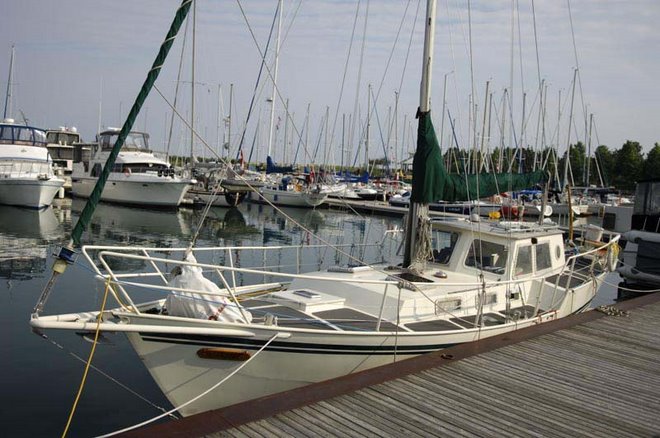
All things considered, not bad for a 40-year-old: a real Boat I Like to Sail


The collision of appalling, barely spring-like weather and its affect on finishing a bunch of needful tasks to make Alchemy watertight for its own launch postponed dealing with Valiente far longer than I had hoped: I could have sailed into our summer berth April 15th instead of 17 days later...hell, the bottom paint was done on April 9th...but I suppose it could be worse: it could be snowing.

An old-school stuffing box will remain on Valiente, as you can't clap a PSS on a direct-drive Atomic 4
Aside from the usual hurry-up-and-wait routine which is to be expected at a busy boat yard in May, boat partner Clive and myself had little in the way of trouble, although his elderly Honda 800 generator blew a fuse trying to power my 10 amp Guest battery charger, and he volunteered to get my Honda 2000 from my house, which involved Toronto traffic so dense that it delayed me on an unloaded bicycle...my offshore readers from this area can feel good about avoiding that downside to an otherwise very nice place to come from. We did the usual last-day-ashore stuff: servicing the thruhulls/seacocks, tightening hose clamps, particularly on hose below the WL, and bringing various chunks (like the Portabote and the boom) out on deck to free up space in the cabin.

Like threading a ten-ton needle
I've posted plenty of launch and haulout pictures in the past, but this time, I have some nice shots of the redoubtable Uli and Clayton maneuvering their impressive gear in what would appear to be extremely close quarters. This rig of hydraulic lift trailer and forklift is about sixty feet or 19 metres in length. From my bow to that gate is about one boat length (35 feet/11 metres). Uli, the yard manager, is driving backwards much of the time and is doing six-point turns...yikes, watching this is a tad nerve-wracking for the uninitiated. I am almost used to it, and Clive, who parks giant passenger jets in narrow airport gates as part of his day job, exhibited frank admiration for the way these guys work efficiently and with clearly well-practised spatial orientation.

The hydraulics are pressurized by yet another small Honda motor. It looks like it's off a lawnmower.

The entire cradle is raised off cinder blocks, only a few inches or so, and is pulled free.

And that's why I don't lower the fenders.

Here you can just make out that the pulpit of one boat is brushing at my aft port lifering as Valiente is hauled out of the crowd. It is not an exaggeration to say I've seen boats pass within one inch/2.5 cm of each other. The economics of boat storage depend on close quartering.

Not seen: The wind had picked up a bit and my stern swung alarmingly close to that shrink-wrap
After a ten-minute trundle around the outside of the ill-defined boat-stowage grounds, it was up, up and away time into a blue sky rarely seen this year until the last week or so.

The first duty...look for water coming in where it shoudn't be.
The engine started right away, although it stalled briefly when put in gear. There was an annoying and fairly significant leak from the newly replaced basket filter to which I attribute a poorly seated gasket ring. Throw in the anticipated dripping from the stuffing box, which tends to need a few days immersed to swell to its nominal "slow drip" state, and I am glad I had the bilge pump in working order. By the time I tied up after a 20 minute chug across the harbour, there were a few dozen litres below.
That ladder will be shortly replaced by a mast
Not a worry, however. I fixed the basket leak and tightened the stuffing box a little until it settles. We'll see if both remedies work the next time I motor, which will be to put the mast in next week.

2013-04-29

Crimping and saving

Cognizant of the fact that much in the way of wiring is before me, I recently made a long-deferred purchase:
In real life, it's much higher resolution.

Behold the Ancor Double Crimp Ratchet Tool. Amazon in the States was having a sale on this and even when some adhesive heat shrink tubing and marine-grade crimp connectors were thrown in, plus the inevitable shipping, it was cheaper to buy online and "foreign".

UPDATE, 2013.05.10: Having used this crimper a fair bit now, I realized that it's important to adjust the little +/- adjustment cog on the side. I had mine too much to the "plus" side, meaning I had to bear down really hard (and I am not a lightly built, stringy individual) in order to get that final "click" of the rachet mechanism that would release the crimp. I found a few notches back gave an equally serviceable crimp (visible as practically solid stranded copper in the middle of the crimp) that I could finish with one hand, and not with a three-pound mallet strike. Still haven't figured out the "release lever", but that doesn't solve the problem of a crimp setting that requires a gorilla's grip.

A bit tinny.
I was schooled (remotely) in the art and science of marine-wire crimping by a character known only as MaineSail, a guy who is like a one-man Practical Sailor of demonstrably good advice and real-world testing on boat repair techniques and products. This photographic tutorial, plus the premature failure of a couple of my own crimps, made me think I needed not only the right tools, but the right techniques to create reliable, strong, and corrosion-resistant crimps.

I am guilty, your lordship, but I promise to do better in the future.
Those interested in the details are encouraged to read MaineSail's excellent treatise, but the gist is this: Marine wire is tinned copper, which resists corrosion, making it last longer (but not forever!) in the terminally damp (pun intended) marine environment of salt air and inevitable splashing. You therefore want tinned connectors.

This fellow gives an introduction:


A second factor is strain relief. A properly crimped connector can support a surprising amount of weight and belies the old idea that twisting a couple of wire ends together and soldering it over (to be followed by a few wraps of Grandpa's best roll of black electrical tape) will suffice.

Look closer. That's a crimp in the middle. Photo from http://www.pbase.com/mainecruising/wire_termination&page=3
A third element is accurate wire stripping. That involves not the home handyman's method of running a pocketknife around the wire and then pulling off the insulation layer with one's teeth...yes, we've all done that...but by using a tool with dies (are we sensing a pattern here?)

Insert "I've known a lot of strippers in my time, but..." joke here.
This is the Ideal Stripmaster. It handles 10-22 AWG wire, sizes that would include the majority of boat electrical work outside of battery lugs and cables, and will strip both stranded (marine standard) and solid (house standard).  As is often the case, I found a place near me with no connection, pun suggested, to the sea or boats: an electrician's tool supply place. I find increasingly that my needs for tools and supplies are met by "industrial" concerns and not "boat gear shops". I also find if I do need something definitely marine, I poke around in professional mariners and fishermen's catalogues to find it, rather than chandleries geared toward the recreational sailor. C'est la sea.

Speaking of battery cables and lugs, they are thick and expensive things that not only vary in price with that of copper and tin as commodities, but which carry high enough currents to get seriously hot if poorly crimped or sealed. And I will need a lot of 'em for my house bank and other parts of the fairly complex charging systems I wish to use. Once again, the mind of MaineSail has produced an excellent primer on the topic, and made a case for doing the job correctly by doing it for oneself.

Like this. Photo from http://www.pbase.com/mainecruising/battery_cables&page=3
So while many sailors will have heavy crimps made by a shop or a chandlery, I am looking at buying yet another tool to "get 'er done": a hydraulic hand crimping tool:


If I had two 12 VDC batteries that I needed to link to a switch with four or six cables that required crimping with lugs appropriate to Group 27s, I would have a store do it. But I need to do perhaps 20 to 30 8 AWG down to 2/0 AWG crimps of various lugs and high-current conduit connecting L-16s or an equally large form factor of flooded battery, so a tool like this will, in fact, save me money. That's my story, anyway, and I'm sticking to it.

Because boats run electrical power (and increasingly so) in a generally hostile environment, special and generally agreed upon standards constitute best practices. The ABYC documentation (which is similar to that of Transport Canada's rules on boat wiring) on these standards may not be compelling reading unless you've ever had an electrical fire. Nor do they mention the role of anchors in crimp testing. But they do emphasize the strong correlation between a good, tight, moisture-excluding wire crimp and a safer boat where things reliably happen when switches are flipped that don't include a follow-up MAYDAY call. So scrimping on crimping is a false economy.

2013-04-28

What sailor doesn't like a properly wet bottom?

Flags out for launch.

Today's pictorial is brought courtesy of diesel and gravity.

Our boat club's inner basin is shared with a second club and a modest naval base used mainly for the creation of Sea Cadets and marching bands.

A few cheers, sure, but I didn't expect a parade.
Apparently, that old sea dog Prince Philip was in town to do something regimental. It tickles me to think that he somehow looked out the window of the royal limo and spotted Alchemy aloft and later said "I say, Elizabeth, over in the colonies I saw the most astounding flying boat..."

The pre-flight consisted of "slingers" and "linesmen/women" arranging the lifting and pulling items correctly:

The long lines at the quarters are to spin the boat from the ground while it's in the air. Non-trivial labour.
Mrs. Alchemy is the primary painter and appreciates when the finish escapes chipping.

These slings and the hooks and cables to which they are attached weigh a lot and require careful handling.


The crane slated to haul Alchemy's 14 or so tonnes skyward proved to be a snug fit between the remaining boat rows and our forklift shed.

We've used Amherst for some years. They very much know their stuff in a job that doesn't tolerate error.


The bracing legs were extended into gaps between boats and building. Tight fit!
Moving the shed would take some time.


I was a little concerned that a) there was no "cinch belt" used on the slings (the horizontal belt or strap keeps the vertical slings from shifting under load), and b) the forward sling was a little too far aft. These photos seem to suggest I was right as Alchemy takes off in a decidedly bow-down attitude. 
The green tape marks on the top rail indicates the preferred sling positions.

On the other hand, having the forward sling right where the keel bottom meets the angle up to the bow was arguably a less "slide-prone" placement.

Nicer fenders are awaiting deployment. Honest.

Alchemy looks like some sort of secret U-Boat design here.


This is the part where even a modest breeze can cause trouble.


The fellow in the orange vest is actually signalling, not single-handedly lifting our boat.


As soon as Alchemy hit aitch-two-oh, a pressing concern meant I needed the slings to be kept on for a few moments. There was a chance that a few years out of the water had, despite my inspection of seacocks and hose clamps, caused some hole or crack to appear and would allow water in the boat. There was also a possibility that the freshly installed "Dripless Shaft Seal" on the freshly installed drive train would not, in fact, prove to be remotely dripless, and that an operation called "burping" would be required. As would the laboriously wired bilge pump of bigness seen below:


The dichotomy of dry in and wet out remains fascinating.


Non-boat owning readers, or owners of boats with traditional "stuffing boxes" that are supposed to drip into the bilges, may not appreciate the pleasure with which the owner of a just-launched steel boat regards a bone-dry bilge. Steel boats, it is said, rot from the inside out, and all the painting and remediation is ideally linked to the reduction of water on the inside to as close to zero as is possible. If sinks, spills, condensation and shower sumps are, as is customary, going to be part of the boat's working life, then the goal is containment and confinement of whatever water's moving about the boat, timely removal of same, and ventilation sufficient to dry out condensation that can form when a boat filled with warm or warmed air sits in cold water. You could write a book about it, really, but the start point is keeping the water out of the lowest, coldest parts of the hull, the dreaded standing water.

Not seen: Moisture. Seen: Recycled bilge pump hose and a potential wine cellar.
Not a drop was found that day. Very good news for me, for my expert installer Cap'n Matt (this bit being very important to get right, and he'd done a very similar installation on his steel boat Creeation), and good news for the shore crew, who could direct the crane to the next boat and forget about my dramatic needs and go-tos.

And after a misjudgement in steering and "way on" that reflected the skipper's long absence from the hydraulic helm and a second go-around by the tow boat (the engine's in but the fuel system is not) in order to lay her safely on the dock, the very gratifying sight of our future home at her designated berth made both a very long day and a sometimes frustrating winter and spring all worth it.
Heck, she looks a lot bigger in the water than in the cradle!
Further adventures in boat restoration to follow.