Stuffing boxes
 |
| We'll take two dozen, thanks. |
The answer is "you don't bring much stuff". That is, of course, not true. You bring loads of stuff, sometimes a tonne or more, beyond even the obvious weight of gear, fuel, water and tools. You bring food, drink, spares, documents, books, sextants, binoculars, PFDs, foulies, entertainment items, dive equipment, oars, bits, pieces and odds with a side of sods.
I haven't even mentioned the extensive bar or the wine cellar in the driest part of the bilges. Another post, perhaps.
Being conscious, however, that every gram added will slow the boat and cause it to lie infinitesimally lower in the water (generally considered A Bad Thing, particularly by racers), the savvy sailor is quite selective about what comes aboard and stays aboard. Also, boats being dynamic, and sometimes violently so, places, the quest is to Keep Stowage Low and Secured. It's practically a science, but with elements of art and possibly sorcery at play. Fans of Douglas Adams's Dirk Gently stories will recall the impossible couch permanently jammed in his stairwell. Boat stowage holds the same challenges, both physically and temperamentally.
Now, I'm just going to brush the surface of working with the space you've got. Our boat is a steel full-keeler with significant interior stowage volume, so we concentrate more on organization of existing space at this point, not saving space through clever ideas like a collapsible silicon kettle...pretty cool, eh?
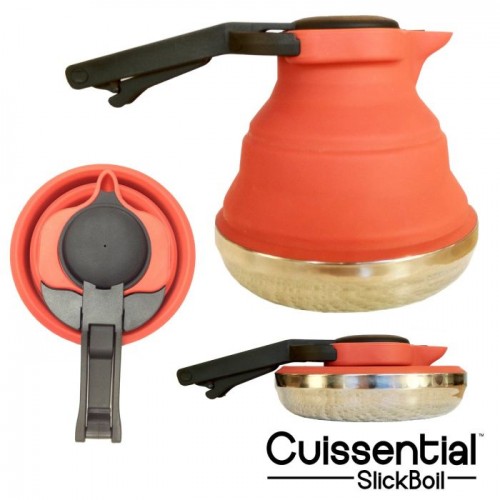 |
| Yeah, that's pretty clever, as long as your tea doesn't taste like sex toys. |
For when modesty prevails
While it is not exactly a secret that certain stages of the cruising lifestyle are clothing-optional, one does not address the Port Captain sans culottes. It's generally a good idea for all but the most hermit-like of cruisers to keep a pair of pressed khakis and a light jacket carefully stowed so that one may appropriately enter certain clubs and offices. Clothing storage is, however, problematic for cruisers due to the need to a) keep wearables stowed well enough to avoid chafe, which means hangers are troublesome, and b) keeping them surrounded by fresh air so damp and mildew are reduced or avoided. There's also the issue of "hump laundry ashore or wash indifferently aboard" for those of us who haven't got Euro-styled appliances in the V-berth, but if you do, you probably don't need to read on about plastic bins. You have people for that sort of thing.
 |
| Modular "condo-sized" ideas can be worked into some boats. |

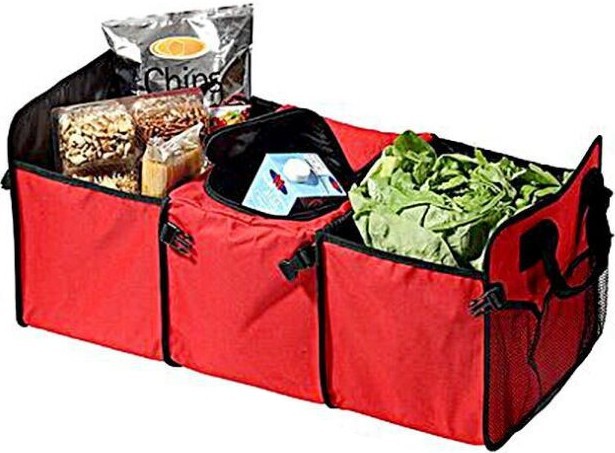 |
| Cloth or impermeable cloth-like plastic are better than cardboard or wood because they can be washed or wiped down. Boats can be wet in places one would think they wouldn't be. |
Even these sort of dollar-store finds are seen on a lot of boats. They don't endure, mind you, but the price is right:

 |
| For a buck or two, if they last six months, it's a deal. |
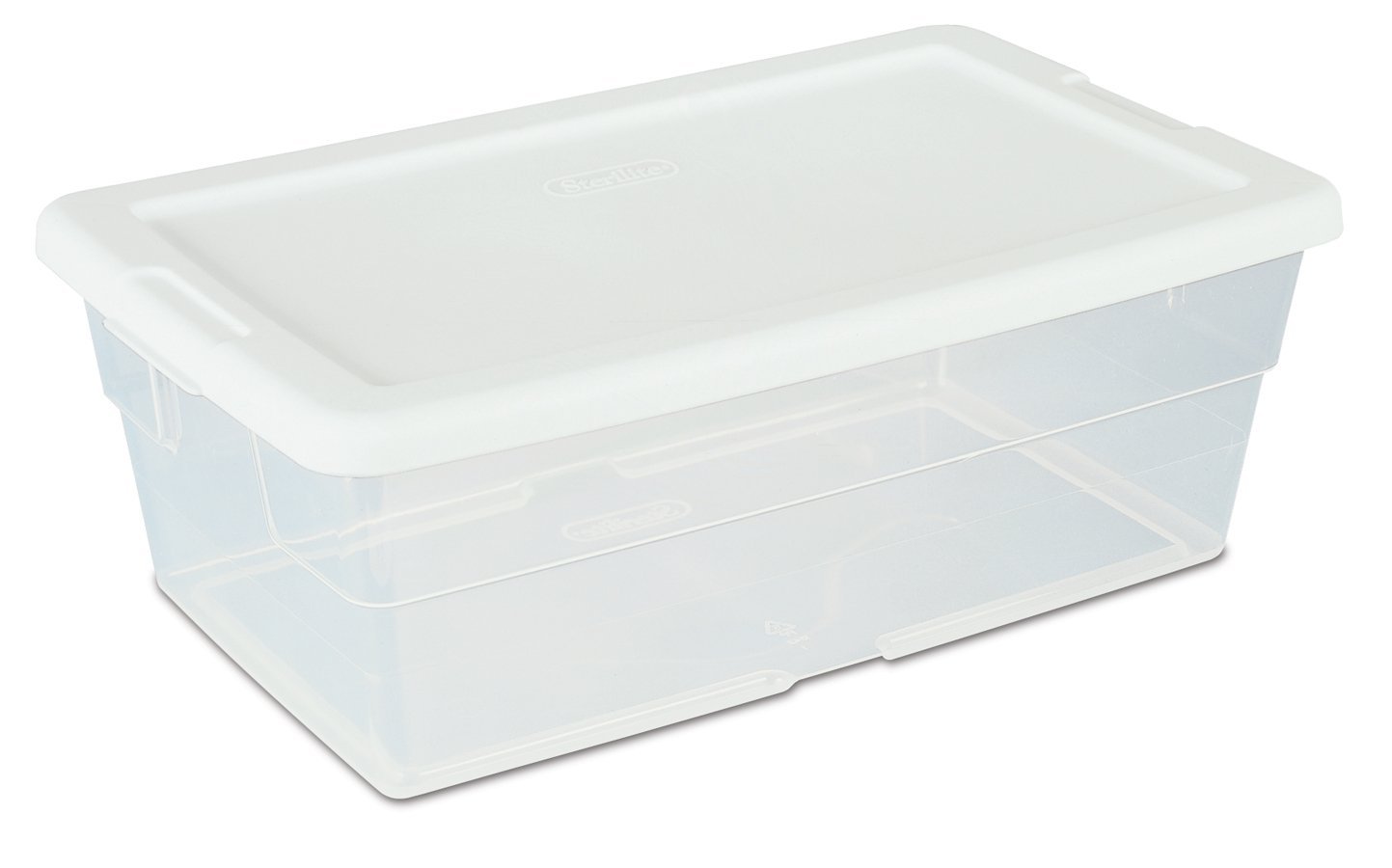
Low, flat plastic lidded boxes, like the kind practical Swedes have to use the space under their beds for clothes storage, are great ways to stow gear and provisions inside lockers. They keep things tightly packed and free of chafe, which can damage the item or the boat itself, and the lids lessen corrosion, particularly if you chuck in little bags of silica to lower the humidity.
 |
| Small Coroplast or similar dividers reduce movement, and therefore chafe. |
 |
| Three drawers for T-shirts and shorts, and the top can hold underwear or swim trunks, secured with plastic wrap. |
...and those which can fold flat for occasional use, like market runs to shore:
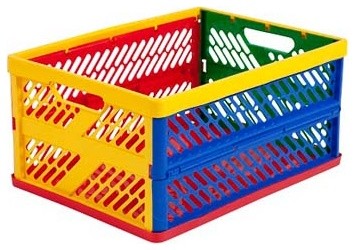 |
| People with two kids in one apartment love this. |
 | |
| You can measure the cubic capacity here and compare it to your galley and fridge capacity so that you avoid "overstock". |
Going ashore and back again
An increasingly popular choice for dinghy or dock is the "crate on wheels" types, which fold flat and some of which are integral to little dolly carts ideal for shopping: |
| I never saw these on the docks until 10 years ago. Now everyone seems to have them. |
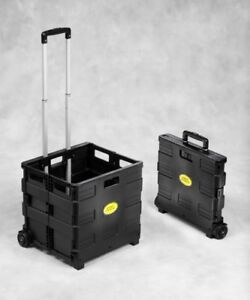 |
| I own one of these and if you don't push the weight, they are handy as dock carts. Sturdier ones no doubt exist; if not, a hand cart could be modified. Ideally, an aluminum hand cart... |
Another tip for the prospective stower is that sticky labels or can labels will NOT survive in salty air; label provisions or spares in ink that succiently describe (even in code, if you wish, co-ordinated with your Excel provisions and spares spreadsheet, which you have, right?) what the tins contain and when they were purchased and/or when the contents expire. This last bit could save your health or could avoid a nasty under-sole explosion. Nothing ruins the sundowner than smelling death in the saloon and having to identify "10,000 NM stew".
 |
| Mark thee well these provisions, laddie! |
Down to the nuts and bolts
If you have the money, and odd, otherwise unusable space on board, there are interesting "built-in tackle boxes" that look like a great way to stow the innumerable bits and pieces essential to boat repair in exotic places.
 |
| Not cheap, but elegant |
I personally think you could get these kind of "tackle boxes" and containers at Fastenal or CTF or any contractor-oriented hardware place and modify an existing lidded box or salvaged cabinetry, but not everyone wants to pay discount.
We've also used for several years some of the gear-stowage solutions from Blue Performance. Some loose gear, like winch handles, bungees, sheets and gloves, are tamed in the cockpit by the sort of organizers that this company seems to have perfected...
 |
| No, not just for racers with budgets |
 |
| Clean and clever |
Tooltastic
After food, water and medical stowage, tools seem to present the biggest storage issue aboard. Keeping them free of rust and working properly is one issue, but keeping them tidy takes real effort and forethought. While most sailor/fixer types would like this: |
| Y'arr...where be me chest braces? |
 |
| Plastic isn't actually a bad choice for the sea life |
 |
| This sort of single clasp will open in one-foot waves. Don't ask how I know. |
 |
| Plastic is a good choice for not rusting and for lightness, but the issues with it include how it can be secured and the strength of the hardware in the drawer slides, which may not endure the movement of a boat in a seaway when the wrenches start to move. |
 |
| Size isn't everything. It's the only thing |
And maybe this:
 |
| I love the little dividers, but those clasps are crap. Flat bungee or lash these tightly. |
Or this:
 |
| Picture every little sub-section labelled. It's my special gift. |
And a few of these, of course:
w~~60_35.JPG) |
| Not seen: Tiny lengths of bungee cord to keep all those drawers shut |
I like to have and can carry a lot of tools in the spirit of self-sufficiency and not being caught without the proverbial nail, the absence of which loses the kingdom. Living on a boat with both metric and SAE hardware means I have to be flexible.
Power tools and the larger sort of hand tool (saws, torque wrenches, breaker bar, big ol' pliers, etc.) will have separately locked bins of their own. The forepeak work area will have a vise and a range of clamps and a light source, but will otherwise be left clear when not in use. Because "unclear" on a boat means "potentially full of projectiles".
Mark thee well
A tip I've picked up from other cruisers and have since implemented on our boat are to label (using the plastic Dymo tape or something similar) EVERY nook and cranny aboard.
 |
| Batteries and patience not included |
I was on a teaky sort of boat of many cubbies that had little Dymo-tape labels on every lid and hatch, each with a number that related to a binder of Extreme Thoroughness. I noticed the labels went well past one hundred. Another way, if you have a more or less symmetrical boat, would be a simple, intuitive code: PG3 would be the third galley locker back from the bow on the port side. This should be related it to a "stowage log" with a line diagram indicating every hidey hole. You can test theory against reality by having a guest find an item without prompting. I follow (so far) a Port (P) and Starboard (S) guide. P1 is the first stowage spot directly under the anchor well... and to the left. Ultimately, how one arranges the stowage is irrelevant (although I wouldn't keep your lead figurine collection in the bow). You can do it from the stern or the bilge or in Japanese. As long as it's current, consistent, reflects reality and possesses an easily grasped, internal logic, you're golden on the quartermastery.
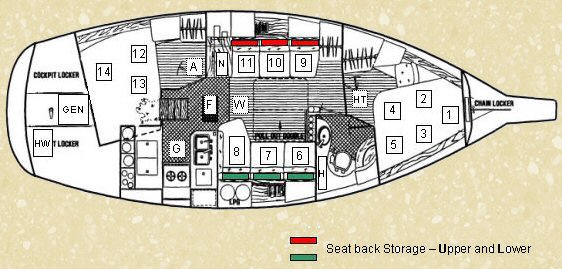 |
| This doesn't have crazy detail, but I would imagine a lot of cursing and rummaging is thereby avoided. Diagram (c) S/V Grainne |
A schematic, either top or side views or both, of the boat with all the numbers marked is at the front of the log, followed by what's in the labelled spot in a written list. This is the same way I stow safety gear in my regular log on Valiente: I have every fire extinguisher, set of flares, flashlights and PFDs marked on a diagram of the boat in the hopes that if I get beaned by the boom at the moment we crunch a container or log, others will be able to solve the situation through rapid equipment locating or at least will be able to help themselves if I am beyond it.
Back to provisions and spares: The canny sailor stows based on weight and ease of access considerations, which may vary if the flats of beer are accessible only through lids under the visiting crew's bunk, for instance. After the schematic and the list shoild come notes listing the amounts and time to replenish estimates. For instance, if you carry four primary filters for the fuel and two lift pump filters, and you are down to two and one, respectively, you trigger an alert, mental, written out or via a spreadsheet notification, to acquire fresh spares. The initial work in setting up an entire boat's worth of food, tools and spares is daunting, yes, but it enables you to avoid running out, and also to acquire if, as is often the case, something useful, something rare or a popular consumable cheaply.
 |
| We've come a long way |
It's pretty easy to keep an Excel file for provisioning. Here's a decent sample of what I mean (thanks to The BoatGalley.com). You may also choose to employ colour codes for the type of thing being stowed by the function or form it takes. A flat plastic box full of tinned soups, for instance, properly marked and dated, might be accessed frequently in higher latitudes and should be coloured "accessible". The prop puller? Let's hope that can be greased, bagged (Ziplock or vacuum-bagged), tagged and buried as low as possible...but not forgotten, thanks to the coded stowage log.
As an aside, a rule I've heard for years among cruisers is that if you don't want insect pests aboard, you must dispose of corrugated cardboard at the dock. While this is inconvenient and it means bringing containers of the folding crate type shown above ashore, it's still the lesser of two weevils.
Another advantage of keeping a stowage and provisioning log is that you can shift stuff around to improve trim based on the weight stowed in individual compartments or lockers. You may also find that you can free up space by creative stowage that can be used to a) purchase more or better provisions, or b) relocate some items you find you buried too deep in the first place.
Now you may make a focus of eating fresh food...a good thing...but it's not always possible to eat freshly at sea or even at anchor...there's something about the walk to the store that may discourage this.
 |
| Must enjoy penguin stew and a touch of gangrene |
You will likely, on passage or island-hopping, be cycling through a ridiculous amount of food, beverages, and coffee: It will mean keeping a good record to avoid distress (we're out of what?) and much of which you purchase will be perishable. Stowage of these items are, beyond the obvious locale of the top-loading fridge, can be found in wire baskets or "breathable" containers in cool spots (don't forget them!). Bunches of green bananas used to be commonly seen in the rigging both to keep them ripening, to keep them fresh, and to keep any interested insects out of the boat.
Keeping a printed or a computer log (both, maybe!) of what you have and, most importantly, where it's kept and for how long, becomes the only way to manage your provisioning and stowage, plus gives you pointers as to whether you can score bargains knowing you have a place aboard to put them.





2 comments:
hi. these are just a,mazing box kits. thanks for sharing.
Collapsible Bulk Containers
Very well said, mate! We use MOST of these practices and are always alert to ideas that keep us free from scurvy and concussions. I love the plano flats for hardware bits and the soft sided tool bags are another "must". What we REALLY need is a hyperdimensional locker, you know, where the inside is bigger than the outside... got a source?
Post a Comment